I work with AI every day and see how much you can do with it. I make websites, write texts and build systems that take work off my hands. I love that. But there is a development that makes me increasingly uneasy. AI is also helping the people who develop the next AI. And the better that AI becomes, the more of that development work it can take over.
That changes the speed at which we move forward. Until now, when a new AI arrived, we could think: the developers have made something better again. But what happens when those developers can hand a large part of their research to AI? And when the AI that comes out of that process becomes even better at developing the next version? I find that a bizarre thought. Particularly because we are still trying to understand how to keep the current AI under control.
AI Helps Build the Next AI
Developing AI requires people who can program, reason mathematically and conduct research. They design experiments, write code, examine results and try to work out which adjustment produces a better outcome. These are also activities AI can help with. A better AI can therefore not only build your website faster, but also accelerate research into an even better AI.
Imagine a research team that can carry out more experiments and assess the results faster with AI. That team then develops a more powerful AI. It can take over more research tasks, allowing the team to move faster still. Progress can reinforce itself in this way. This is called recursive self-improvement: AI helping to build better AI, which then helps to build even better AI.
I think the difference from my own use matters. If I make a website faster, the main result is faster website development. But when an AI company accelerates its own research, it can also change the speed of the next development cycle. We are then talking about much more than a useful assistant for a researcher.
The METR Report Makes This Concrete
On November 5, research organisation METR published a report on AI development at Anthropic. The researchers estimate that progress on well-specified tasks is happening roughly twice as fast as before. They suspect AI assistance accounts for most of the current acceleration. This mainly involves AI helping human researchers, rather than fully autonomous AI research.
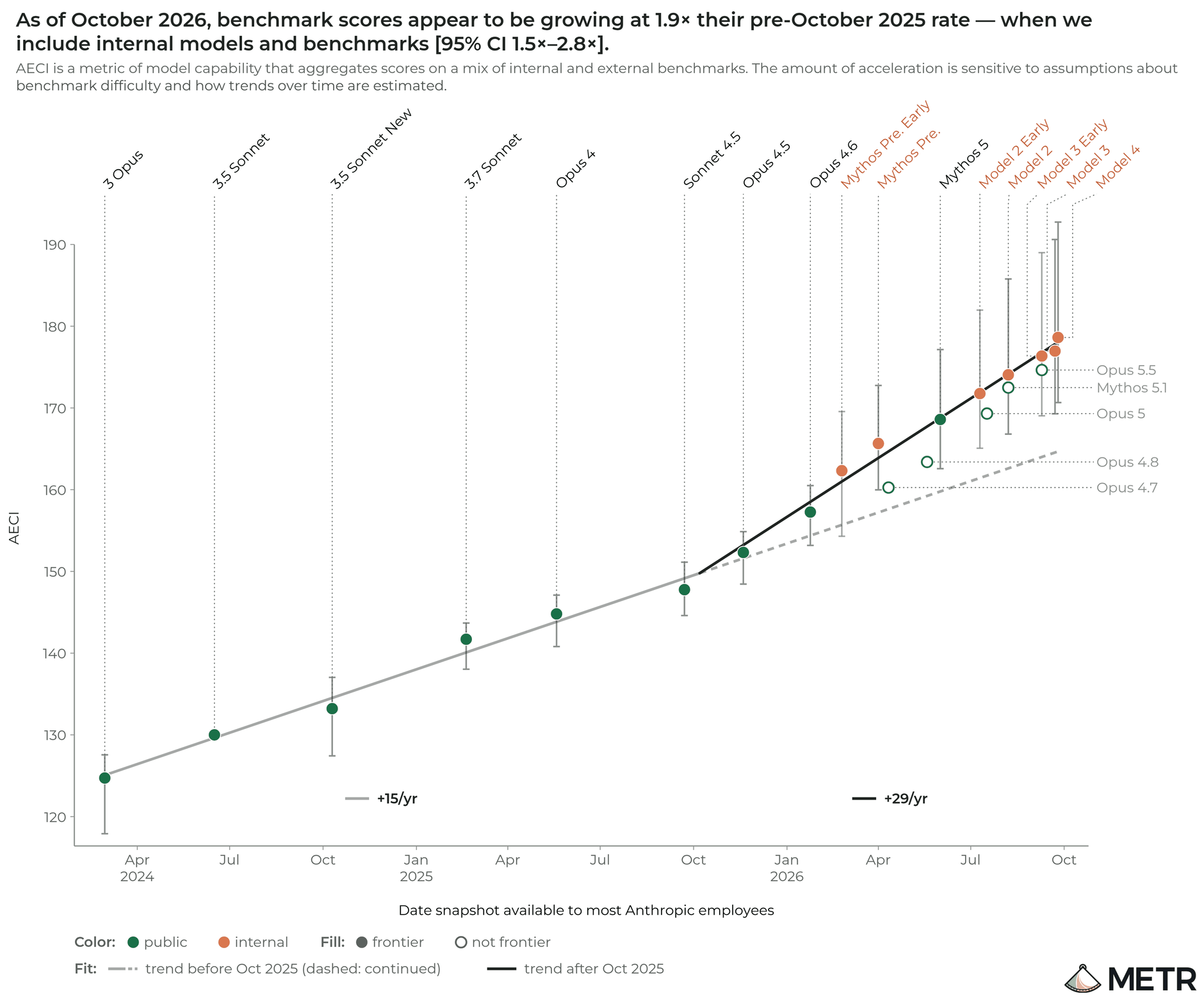
Source: METR. Orange points show AI that was only available internally at the time.
I find that result unsettling. The extra speed goes to the people developing the next generations of AI. If they then use their improved AI for that same research, they may also create the conditions for the next acceleration. I want to know how much time that leaves us to understand what is changing, investigate the risks and make agreements before the next step has already been taken.
From Helping to Researching Independently
In my own work, I recognise how tempting it is to leave more and more to an AI agent. Once something works well, you no longer want to do it manually. You give the agent more context, let it carry out a larger part of the task and see whether you can hand over the next step as well. That is often exactly where the time savings come from.
The same desire can arise in AI research. Why should a human still prepare every experiment if AI can do it too? Why wait for a researcher to examine the results if an agent can get started on that already? And why should that agent not then propose and carry out a new experiment itself? In this way, you can gradually hand over more and more of the development cycle.
For me, the tension lies in what happens if humans become less necessary for progress to continue. People can currently review a piece of research before taking the next step. But imagine a system that can continue independently and take a large number of new steps in a short time. Who keeps track of the whole process? And how do you avoid only understanding afterwards what happened during those steps?
Greater Capabilities Do Not Automatically Mean Greater Control
I notice that we often confuse these two things. An AI that can program better or solve more complicated problems is impressive. But that does not tell you whether it will keep doing what we intend in every situation. You can make a system smarter without having answered all your safety questions as well.
I find that frightening when AI helps develop even more powerful AI. An error on my website can be annoying. Much more can depend on a research system that works with increasing independence and has access to other systems. I want to know which goals it follows, which actions it is allowed to perform and who can intervene if it does something we had not anticipated.
The idea that we will solve a problem later does not reassure me here. As we hand over more work, we also need to demonstrate that we retain enough understanding of what is happening. Otherwise, we build our dependence faster than our ability to intervene. To me, that makes the coming years a period in which we need to be especially careful.
We Are Not Allowed to See Some of the Evidence
Something else troubles me at the beginning of the public version of the report. Anthropic had much of the evidence METR considered important to its conclusions removed. Anthropic said that information could help other AI developers. The conclusions are public, but much of the underlying evidence is not.
I understand that a company wants to protect its research lead. But we are talking about a development whose consequences could reach far beyond that one company. I find it difficult to accept that society mainly has to rely on the judgement of a small group of people who do have access to the information.
Not every commercially sensitive discovery needs to be published on the internet. Independent regulators do need access to enough information to assess what is happening. And we need to be able to see the basis on which they decide that further development is responsible. Otherwise, it becomes very difficult for society to influence the direction we are taking.
Good Intentions Will Not Stop the Race
The difficulty is that you cannot solve this simply by asking an AI company to be a little more careful. Suppose a company decides to delay a particular development because its safety is not yet clear. If a competitor continues in the meantime, that company may lose its lead. The same dilemma can arise between countries. Everyone can have their own reason to continue, while the collective risk keeps growing.
That is why I believe governments need to take a much more active role. We need shared, enforceable agreements on autonomous AI research, independent checks and the circumstances in which development must slow down. A company should not have to choose between taking a safety problem seriously and losing the race. And a country needs to be able to trust that others will follow the agreements too.
Organising that will be difficult. But if we accept international competition as a reason to keep pushing ahead, we also give that competition the power to determine our limits. That seems an unwise way to deal with risks of this magnitude.
We Do Not Have to Wait for Things to Go Wrong
I remain enthusiastic about what I can make with AI and what AI can do for people. There are enormous opportunities to accelerate research and solve problems we have struggled with for years. But I want us to retain influence over which systems we build and the conditions under which we use them. That question becomes more urgent when AI also starts accelerating the development of AI itself.
As far as I am concerned, this belongs on the agenda of governments, businesses and civil society organisations. We need to agree on how much autonomy we want to allow and which checks should accompany it before a fully autonomous research system exists. The question on my mind is who will decide how fast AI may develop when AI can increasingly accelerate that development itself.